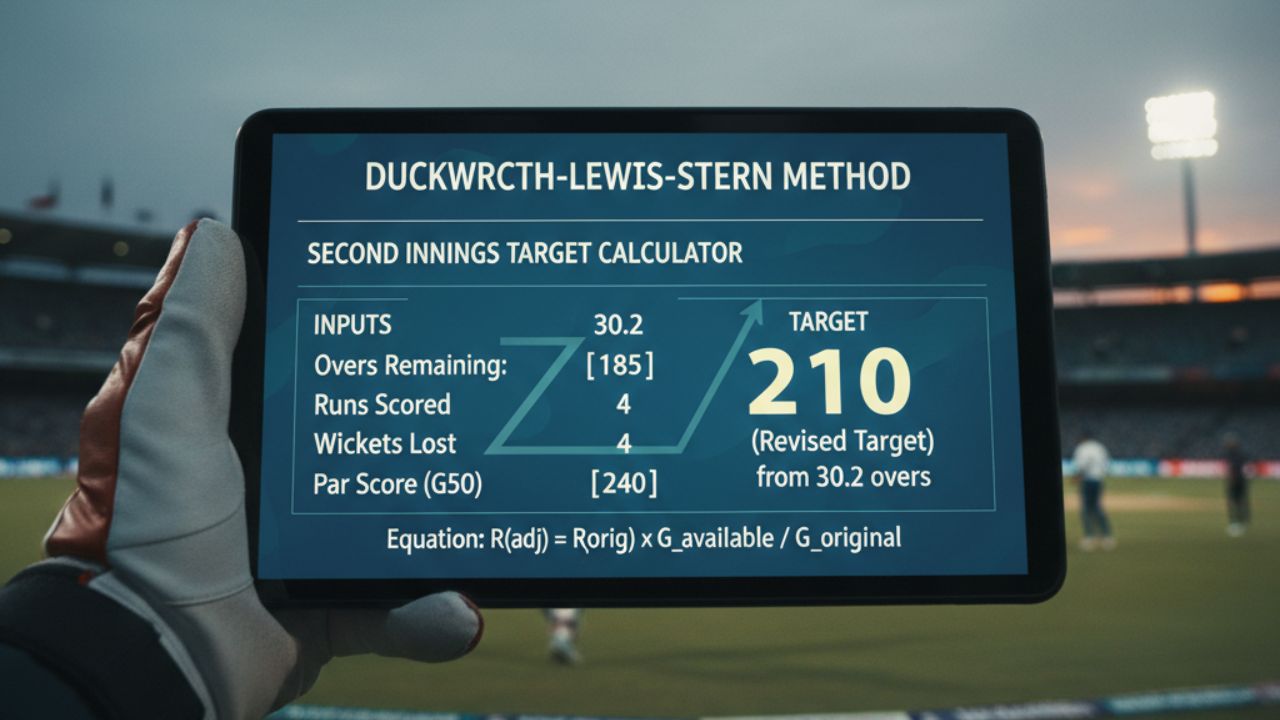
DLS Second Innings Calculator
Determine the Par Score and Winning Target for the chasing team at any point in the innings.
Second Innings DLS FAQs
The Par Score is the exact number of runs the team batting second should have scored to be considered “level” with Team 1, given the number of overs used and wickets lost. If they are exactly on this score when play stops, the match is a Tie.
Wickets are a vital resource in DLS. If you lose a wicket, your “Resource Percentage” drops significantly. To compensate for having fewer tools to finish the job, the math requires you to have more runs already on the board.
In 2026 ICC regulations, at least 5 overs must be completed in the second innings for a T20 match to have a result, and 20 overs for an ODI. If rain stops play before this, the match is a “No Result.”
In a second innings chase, the target usually only *decreases* if overs are lost. However, if the interruption happens and Team 2 is given a fresh start with fewer overs, the DLS math often sets a higher required run rate because Team 2 can bat more aggressively with their remaining wickets.
During a chase, officials provide a sheet to the captains showing the Par Score for every over and wicket combination. This helps the chasing team know exactly how many runs they need to be “safe” before every ball.
Since DLS is calculated ball-by-ball, extras that add runs but don’t use up a legal delivery help the chasing team’s score without reducing their “Over” resource, making it easier to stay above the Par Score.
The method is currently managed by **Steven Stern**, a data scientist who updated the original Duckworth-Lewis system to the “Duckworth-Lewis-Stern” (DLS) method to better reflect high-scoring modern T20 cricket.
Yes. If Team 1 had their overs reduced, their resource was limited. DLS adjusts the target for Team 2 based on the relative resources available to both sides during their respective innings.
Steven Stern introduced updated constants that account for the accelerated scoring rates in the death overs of modern cricket. This makes the Par Score higher than it used to be under the old DL method.
If the chasing team’s score is exactly equal to the Par Score when the match is called off, it is recorded as a Tie. In tournament knockout stages, this usually leads to a Super Over if conditions allow.
Duckworth Lewis Calculator For Second Innings
Cricket, often called the gentleman’s game, is a sport governed by complex rules, elegant strategies, and, crucially, unpredictable weather. In the modern era of limited-overs cricket—One Day Internationals (ODIs) and Twenty20s (T20s)—a simple draw is rarely the desired outcome. The goal is always a definitive result.
But what happens when the heavens open, a match is interrupted, and the playing time is drastically cut? Before the late 1990s, the solutions were often rudimentary, unfair, and occasionally bordering on farcical. The most infamous example remains the 1992 World Cup semi-final, where rain left South Africa needing an impossible 22 runs from 1 ball.
The need for a statistically sound, equitable, and universally applicable solution gave rise to the system we now know as the Duckworth-Lewis-Stern method. It is, quite simply, the essential mathematical framework that saves limited-overs cricket from the tyranny of the rain gods.
The Core Concept: Resource Management
To truly appreciate the DLS method, we must discard the idea of simply reducing a run target based on a proportional loss of overs. The genius of the DLS calculation lies in its recognition that a batting team uses two interconnected resources to score runs:
- Overs Remaining (Time): The number of balls they have left to face.
- Wickets in Hand (Safety/Aggression): The number of remaining batsmen, which dictates the level of risk and aggression they can employ.
These two resources are not independent; they work together exponentially. A team with 5 wickets and 10 overs left is in a vastly stronger position than a team with 1 wicket and 10 overs left, even though the number of overs remaining is the same.
The DLS method assigns a combined Resource Percentage to every possible combination of overs and wickets remaining, based on historical run-scoring data. A full 50-over innings with 10 wickets is set as 100% of the scoring resource.
How the DLS Method Works in Practice
The DLS calculation is fundamentally based on a ratio of resources available to the two competing teams. The formula is:
$$ \text{Revised Target (Team 2)} = \text{Team 1 Final Score} \times \frac{\text{Resources Available to Team 2}}{\text{Resources Available to Team 1}} $$
This resource ratio ensures that the difficulty of the target remains constant, even if the target number changes.
The Second Innings Interruption
The most common application, which our calculator simulates, occurs when the team batting first (Team 1) completes its full innings, and the second team (Team 2) is chasing when rain halts play, and overs are subsequently lost.
- Team 1’s Resources (R1): Since Team 1 completed its innings without loss of overs, R1 is typically 100%. (For simplicity, we assume R1 = 100% in this scenario).
- Team 2’s Resources (R2): When the match is stopped and restarted with fewer overs, Team 2 has lost a portion of its original 100% resource. The DLS system looks at the exact moment of interruption (overs left and wickets lost) and calculates the resource lost due to the reduction in play.
- The New Target: If Team 1 scored 280 runs using 100% of resources, and Team 2 now only has 85% of its potential resources left to play with, their revised target is: 280×(85%/100%)=238 runs.
The crucial detail here is the Par Score. The DLS system first determines the Par Score—the score Team 2 should have reached at the exact moment of interruption to be level with the run rate difficulty. The Target Score to win is always the Par Score rounded up to the next integer (Par Score + 1).
From D/L to DLS: The Stern Refinement
The original method was devised by statisticians Frank Duckworth and Tony Lewis (D/L). While groundbreaking, cricket evolved quickly. Run rates increased dramatically, driven by T20 cricket, bigger bats, and more aggressive batting strategies.
In 2014, when Duckworth and Lewis retired, Professor Steven Stern took over as the custodian of the method. He introduced key adjustments to the algorithm to better reflect these modern, higher-scoring trends.
The updated and current official formula is known as the Duckworth-Lewis-Stern (DLS) Method. This professional edition is highly complex, constantly updated, and requires specialized software (used by match officials) to be calculated with official precision.
The Role of the Calculator
So, if the official method is complex, why use a calculator?
Tools like the one presented above serve a vital purpose for fans, journalists, and amateur leagues. They simplify the core mechanism of DLS, illustrating how overs and wickets interact to adjust the target.
The Problem with Simple Averages
Imagine a scenario:
- Team 1 scores 200 in 40 overs (Run Rate: 5.0 RPO).
- Team 2 chases and is 100/1 in 20 overs when rain stops play. 20 overs are lost.
If we used the old Average Run Rate (ARR) method, Team 2 would need to maintain a 5.0 RPO. If they only have 20 overs left, their target is simply 200×(20/40)=100 (plus one to win).
This is unfair! The ARR method fails to account for the fact that Team 2 has 9 wickets in hand and can now play hyper-aggressively knowing they only need a run-a-ball target in a much shorter span.
DLS rectifies this by penalizing the resources lost while factoring in the high wicket count, ensuring the revised target is statistically as challenging as the original one.
Criticisms and the Verdict on DLS
Despite being the global standard endorsed by the ICC, the DLS method is not immune to criticism.
1. Complexity and Lack of Transparency
For the average spectator, the complex mathematical modeling—which relies on exponential functions and proprietary data tables—remains opaque. As one famous cricketer quipped, “I don’t even try to understand it. I just look at the sheet of paper given to me!” This complexity can lead to confusion and perceived unfairness in the stands.
2. Edge Cases and Timing Bias
Critics argue that the timing of the interruption can still unintentionally favor one team.
For instance, if rain halts play just as a powerful, set batsman is about to launch an all-out assault in the final overs, the target revision might not fully capture the massive scoring potential that was about to be unleashed. Similarly, the method faces challenges in extreme high-scoring matches, where historical resource data may be less predictive.
3. The Winner’s Choice
DLS must decide whether to reduce the target (when the chasing team loses resources) or increase the required run rate (when the team batting first loses overs). This careful balancing act sometimes leads to bizarre moments, although the method is mathematically sound in maintaining the statistical equilibrium of the contest.
Ultimately, DLS is the best solution cricket has ever implemented. It is a necessary evil—a highly sophisticated, scientifically grounded effort to bring fairness to the most frustrating aspect of outdoor sport. It ensures that when rain falls, the outcome is determined by math, not just misfortune.